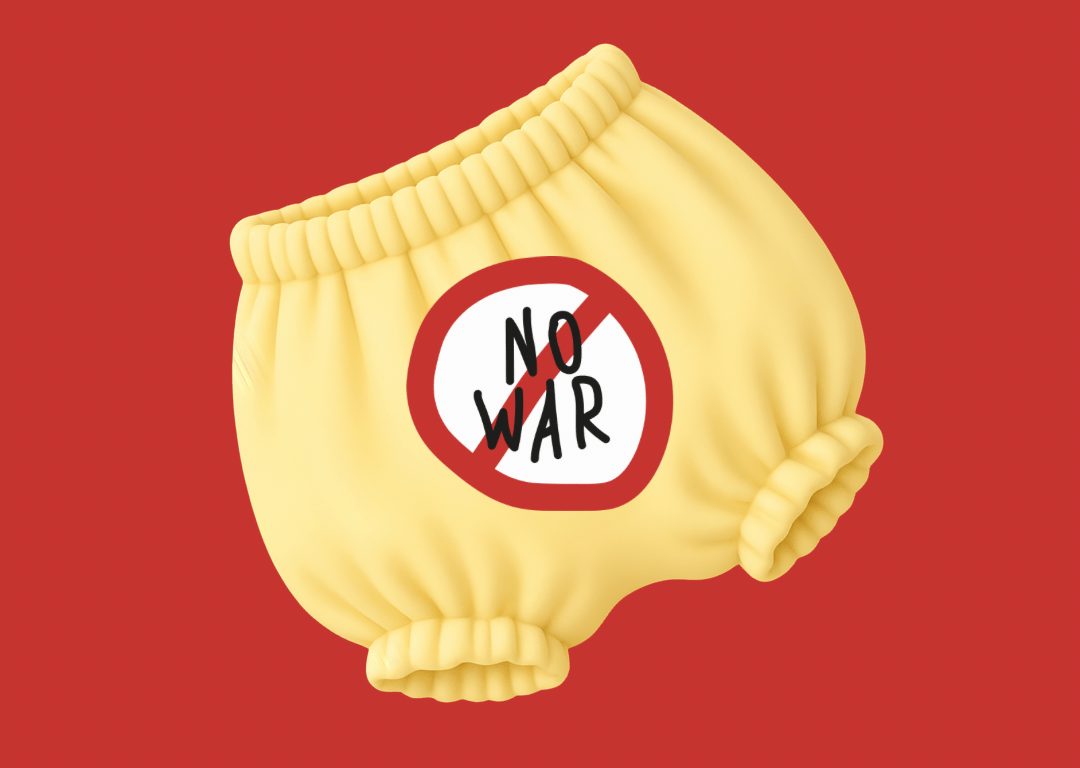
Pacifist, not passive.
In summary: Knickers to War™ is a self-funded opinion website about ending male violence, including war. It speaks from a pacifist lens, incorporating spirituality and feminist theory. Content may occasionally read like rants.
The name is a nod to the women of Greenham Common, who used humour to highlight the absurdity of decision making when it came to choices over military spending, and recognised the real dangers women faced from men who attempted to claim ownership of their bodies.
This reality still exists for millions of women globally today; with or without war, women are still at risk from violent men.
Knickers to War™ was inspired by a visit to an exhibition at (of all places) one of the Imperial War Museums (Duxford).
The exhibition told the story of Anna Johnson, who protested at Greenham Common, for 18 months, against the presence of nuclear missiles.
The exhibition explained that, at the time, Newbury Council had attempted to change the byelaws, to make the women’s camps at Greenham Common illegal, but this was overturned by the House of Lords. Anna contributed a pair of pants to the ‘Knickers to the Byelaws” campaign, and a photo of them, pinned to the railings, is on display at the museum.
The humour used by activists at Greenham Common was cheeky, strategic and brilliantly political – it’s a reminder that resistance to war can be intelligent, human and, importantly, nonviolent. The tactic was intentionally playful and confrontational, using humour to undermine authority. It was a way of reclaiming agency in a militarised space, and highlight how male-dominance, in a variety of forms, limits choices for women. “Knickers to the Byelaws” mocked the absurdity of policing women’s bodies (and criminalise peaceful protest), for example, while simultaneously spending billions on nuclear weapons under the banner of “safety”.
The phrase “Knickers to War™” therefore attempts to honour a lineage of brilliant women, with contemporary pacifist activism in the digital space, continuing to puncture the myth that militarism is inevitable or respectable. It holds a mirror up to decision makers’ choices – and priorities – on spending (for example), and asks when people talk about national defence and safety, whose safety do we mean?
Because with or without war, millions of women globally continue to be harmed by male violence, including violent conflict, today.
⚠️ Content Warning
The articles on this website often refer to predominantly male perpetrated violence, including domestic abuse, sexual violence, harassment and femicide, as well as women’s health inequalities, especially as a result of conflict and war. It particularly discusses the impact of misogyny and male supremacy.
The author writes from lived experience of domestic abuse, alongside her therapeutic background of more than two decades working as a qualified counsellor and trauma-informed educator. This included supporting victims subjected to male violence and families bereaved by it. The author acknowledges that people of all genders can be harmed by violence – and can be violent – but this website centres the realities for women. The website is trans inclusive.
If the content doesn’t reflect your lived experience, readers are encouraged to set up their own website, within their means, on topics close to their heart. Readers are also encouraged to read these terms before accessing the content library or engaging with content from it.
If you are affected by any of the topics covered on this website you may find these links of interest.
Principles
There are actually several key principles discussed throughout this website, however here’s one important detail: the research now shows that all humans are capable of compassion from a young age; babies demonstrate empathy before they can even speak.
We are not born violent.
We are not born hating anyone.
This is the good news.
A behaviour that has been learned can be unlearned; the science asserts that humans have the capacity for change, even when it’s hard.
So while this content centres the harm caused to women and girls by some men, the author also believes in men’s potential for upstandership, their collective power to prevent violence, and their ability to facilitate change.
It also emphasises that:
War is not destiny.
Militarism is not common sense.
Peace is not passivity.
This content promotes strategic, intelligent pacifism – the kind that understands power, challenges harmful narratives, and ask us to consider building safety through community rather than force.
It demonstrates:
the courage to question militarised masculinity
the conviction that humour can be a “weapon” to disarm the posturing of war culture
the knowledge that ordinary people can shift the culture of conflict.
Knickers are also a reminder that our bodies – and our lives – should never be collateral in someone else’s geopolitical theatre. Women are predominantly impacted by war, whether through sexual violence or care giving and yet also overlooked. Well, knickers to that.
Who is the behind this website?
That would be Delphi, a qualified counsellor and educator who writes from a pacifist, (non-denominational) spiritual and feminist perspective. As the ethos of this website hopefully shows, pacifism is not the same as passive, feminism does not mean excluding men, and spirituality doesn’t always mean talking about religion.
In the context of this website, Delphi blends Quaker principles, Buddhist philosophy and a belief that God loves women. As a trauma-informed educator, she is well aware of the role that trauma plays in peoples lives. However, the author also asserts that violence is a choice and making excuses for violence doesn’t help anyone – neither the harmed nor the harm doer. Helped people help people, not harm them.
This website therefore adopts the principle of fierce compassion, which, while it focuses on nonviolence and not harming others, also means not making excuses for or staying silent while some do. You can read more about Delphi here.
 Knickers to War™
You must be logged in to post a comment.